


PART 1 · INTRODUCTION
Lesson 1. Why do projects fail?
Reading time ≈ 15 min · Based on Chapter 1 of the book
Do not look at whether others act or fail to act; look at yourself, at whether you act or fail to act.
— After the Dhammapada
| LEARNING OBJECTIVES
After this lesson you will be able to: • Explain why project success rates remain very low despite many standards and certifications. • Identify the five “chronic diseases” that make projects fail and how they show up in practice. • Understand “inner sage, outer leader” as the framework that runs through the whole course. • Examine your own responsibility before looking for outside causes. |
International bodies have issued many project management principles, methods and processes, and millions of people have been trained and certified. Yet the real success rate of projects remains very low. This opening lesson asks: where does the problem lie?
A sobering statistic
The book How Big Things Get Done draws on a database of some 16,000 projects and shows:
| 8.5%
meet both cost and schedule Fewer than one project in ten finishes on time and within budget. |
0.5%
deliver cost, schedule and benefits Only one project in 200 delivers the benefits it promised. |
When projects fail, we tend to cite many causes, some internal, some external. Rarely do we ask ourselves honestly:
- Did I let prejudice, bias or self-interest drive my decisions?
- Did I lack the knowledge and skills needed to complete the project?
- Was I impatient, chasing an appearance of achievement?
- Did I push responsibility away or blame others?
That honest self-examination reveals five chronic diseases that lead projects to failure.
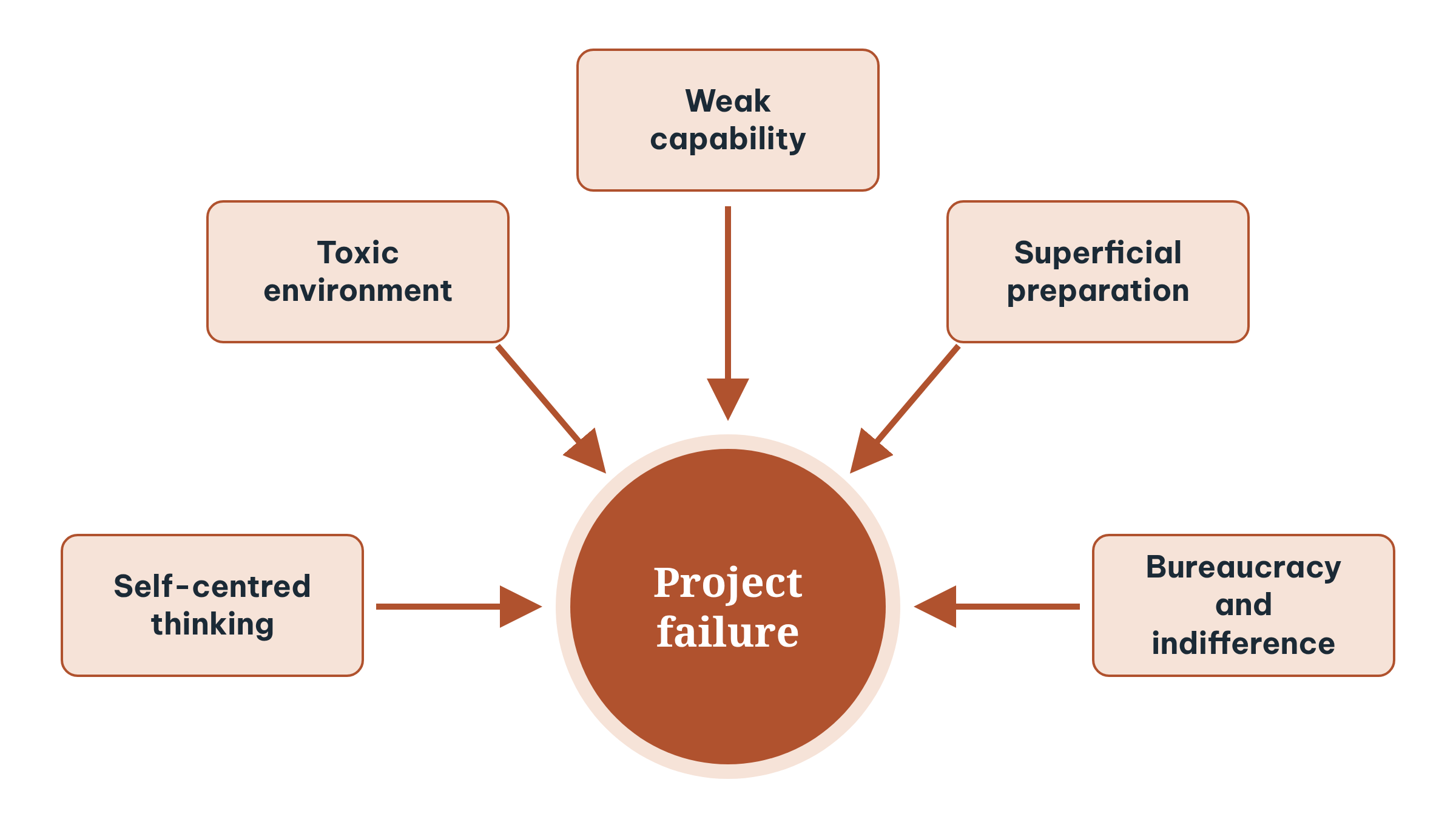
Figure 1.1. The causes of project failure: self-centred thinking, a toxic environment, weak capability, superficial preparation, and bureaucracy and indifference.
Disease 1: Self-centred thinking
| CONCEPT
Project risk is a future event that may occur and would affect the project. |
Projects face many kinds of risk, but the greatest risk lies in each person working on the project. From the highest authority, the sponsor and the project director, down to engineers and staff, everyone adds to the overall risk through their behaviour, judgement and decisions.
Prejudice, bias and ego-centred thinking often steer our choices “unconsciously”: favouring relatives, picking a “familiar” contractor, dismissing views that run against our interests, or deciding in haste on missing or distorted data.
No one can remove bias completely. But when we recognise it and test our decisions against the ten universal intellectual standards, we become more careful and fair:
| Clarity | Accuracy | Precision | Relevance | Depth |
| Breadth | Logic | Significance | Fairness | Completeness |
Disease 2: A toxic project environment
An unhealthy environment is the direct result of “toxic” leadership. The book describes four typical types:
| The avoider
Delays or dodges the important decisions of the project. |
The know-it-all
Always right, never listens, decides on a whim. |
| The manipulator
Plays favourites and divides the team. |
The schemer
Plots to serve personal interest; the most harmful of all. |
The seeds of all four exist in each of us. Our task is to recognise them and not let them sprout, by mastering body and mind and living by ethical values.
More broadly, toxic environments also grow from common practices between parties:
- Choosing the lowest-price contractor while compromising on capability and experience criteria.
- Negotiating contracts to minimise one’s own cost and push maximum risk to the other side, regardless of whether that party can manage the risk.
The result is “islands of interest”: little trust, no data sharing, and in the end claims, disputes, delays and cost overruns.
Disease 3: Weak delivery capability
Weak capability shows in four ways: staff who are not truly proficient, bloated organisation structures, unclear roles and responsibilities, and overlapping delegation of authority.
- No competency standards: project directors are chosen through “familiar relationships” or unhealthy competition. Below-standard people in leadership roles often fall into one of the four toxic leadership types, doing double damage.
- Paper organisation charts: a chart that shows neither hierarchy nor roles; or a good chart filled with unsuitable people, like “trimming the foot to fit the shoe”.
- Arbitrary delegation: unclear duties that change with the leader’s mood, leading to inconsistent decisions.
Disease 4: Superficial preparation, hasty management
“Surface-level plans, hurried commitments, quick groundbreaking” is a common way of running projects. Many projects hold a grand groundbreaking ceremony and then fall silent. Typical gaps:
- Work is left out; the resources actually available are not considered.
- Stakeholders are not analysed to invite their participation and cooperation.
- Cost estimates are unreliable; risks are mentioned only in passing.
- Completion milestones are imposed from above instead of being built carefully and feasibly.
| WARNING: “TECHNICAL COMPLETION”
Some projects chase a milestone set from above and then add the word “technical”: the works are declared “complete” before all technical requirements are met, a celebration is held, and the plant is “handed back” to the contractor to clear the backlog. It is not rare for such plants to fail once in service, costing more money and time. The question to reflect on: a moment of achievement, or a waste of resources? |
Disease 5: Bureaucracy and indifference
We live in a volatile world, with uncertainty in law, politics, environment, climate and technology. However carefully a plan is prepared, there will be deviations, not to mention unforeseeable “black swan” events.
| When parties are transparent and timely
Early warnings of deviation are raised and fixed early; when a major event hits, the parties negotiate new targets on a “win-win” basis and the project continues its journey. |
When bureaucracy rules
Approvals pass through many levels, responsibility is pushed around, decisions come late. Problems accumulate, recovery becomes harder, and disputes, delays and overruns grow very large. |
The way of “inner sage, outer leader”
The Taoist classic Zhuangzi (known in Vietnam as Nam Hoa Kinh) laments that when the way of “inner sage, outer king” (nội thánh, ngoại vương) is forgotten, people simply follow their own desires. It is because we forget this way that we suffer the five diseases above.
| INNER SAGE · WITHIN
Cultivate and build the foundation Cultivate professional ethics, build a distinctive culture, develop competence. |
OUTER LEADER · WITHOUT
Apply and lead Apply knowledge, skills, tools and technology; plan proactively and thoroughly; lead flexibly and adaptively. |
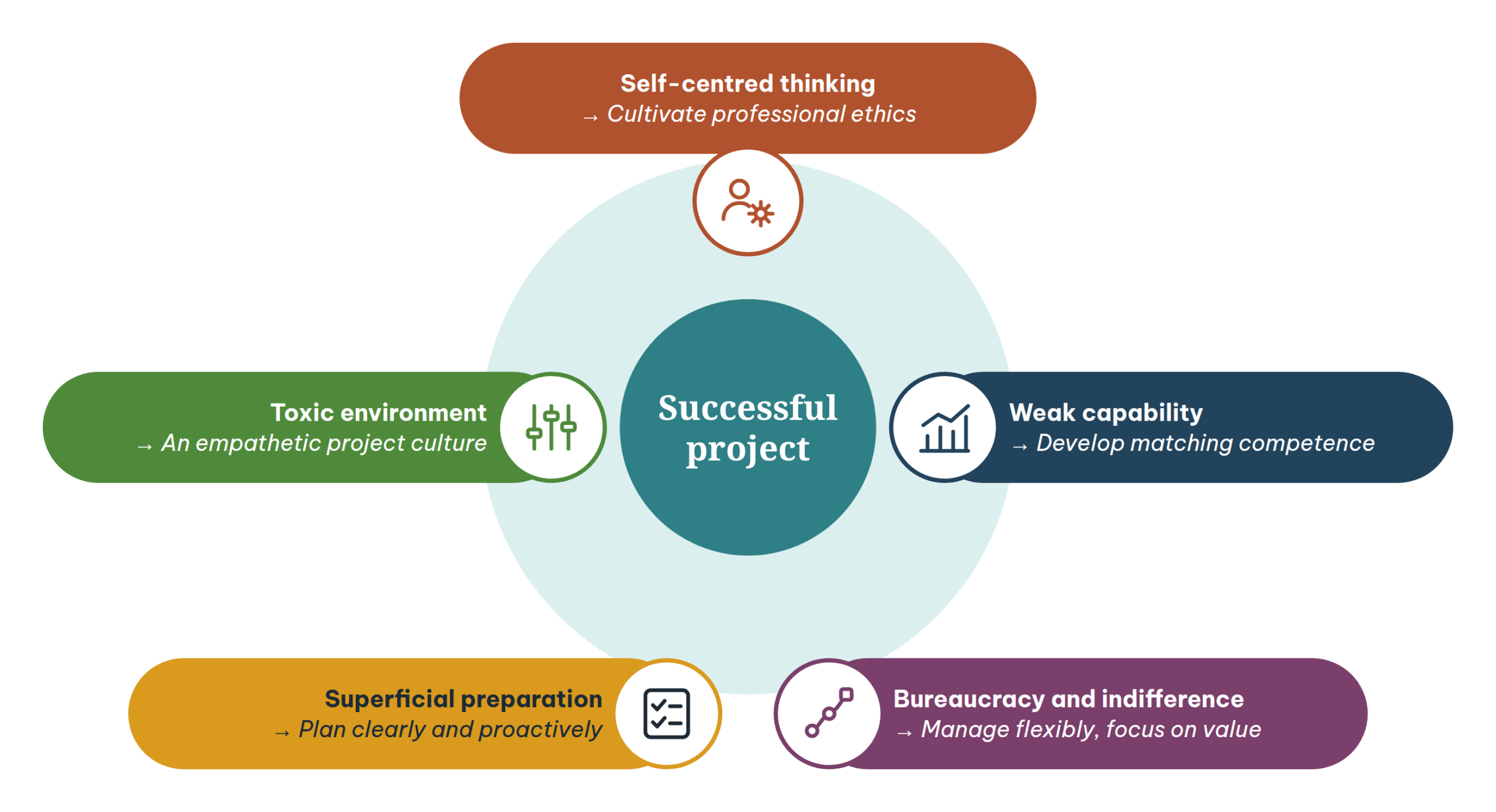
Figure 1.2. The principles of project success: each disease has its remedy.
These five principles also form the structure of the course:
| Disease | Remedy | Covered in |
| Self-centred thinking | Cultivate professional ethics | Lessons 2–3 |
| Toxic project environment | An empathetic project culture | Lessons 4–6 |
| Weak delivery capability | Develop matching competence, build the organisation | Lessons 7–12 |
| Superficial preparation, hasty management | Choose the right project, plan proactively | Lessons 13–15 |
| Bureaucracy and indifference | Manage flexibly, focus on value | Lessons 16–19 |
Apply it to your project
| A QUICK HEALTH CHECK OF YOUR CURRENT PROJECT
Tick the signs you are seeing. Each one is a “symptom” worth attention. ☐ Some selections (people, contractors) were made mainly on relationships rather than capability. ☐ People hesitate to voice opposing views in meetings. ☐ Roles and authority for some positions are unclear or keep changing. ☐ The completion date was fixed before a feasible detailed schedule existed. ☐ Risks are listed for form’s sake, with no response plans. ☐ Issues must pass through many levels and wait months for a decision. |
Reflection questions
| FOR INDIVIDUAL REFLECTION OR GROUP DISCUSSION
1. Recall a project you worked on that ran late or over budget. Which of the five diseases was most visible? How did you contribute to it, even in a small way? 2. In your organisation, are completion milestones built from the bottom up or imposed from the top? What are the consequences? 3. If you chose one “inner sage” action and one “outer leader” action to start this week, what would they be? |
Quick check
Question 1. According to the database of about 16,000 projects cited in the lesson, what share delivered cost, schedule and benefits?
- 8.5%
- 0.5%
- 25%
- 50%
Question 2. According to the author, where does the greatest project risk lie?
- Volatile material prices
- Black swan events
- In each person working on the project
- Foreign contractors
Question 3. “Technical completion” is presented as a symptom of which disease?
- Bureaucracy and indifference
- Superficial preparation and hasty management
- A toxic project environment
- Weak delivery capability
Question 4. Which of these belongs to the “outer leader”?
- Cultivating professional ethics
- Building a distinctive culture
- Preparing plans proactively and thoroughly
- Developing one’s own competence
Answers and explanations
Question 1: B. Only 8.5% met both cost and schedule; when benefits are added, the figure drops to 0.5%.
Question 2: C. Everyone, from top leadership to staff, adds to overall risk through their behaviour, judgement and decisions.
Question 3: B. Chasing an imposed milestone to report success, then clearing the backlog later, results from superficial preparation and haste.
Question 4: C. Inner sage is ethics, culture and competence; outer leader is applying knowledge, planning proactively and leading flexibly.
Key points
| THE ESSENTIALS OF THIS LESSON
• Only about 8.5% of projects meet both cost and schedule; 0.5% deliver cost, schedule and benefits. Knowledge and certificates are not enough for success. • The biggest project risk lies in each person on the project, through behaviour, judgement and decisions shaped by bias and ego. • The five chronic diseases are self-centred thinking; a toxic project environment; weak delivery capability; superficial preparation and hasty management; bureaucracy and indifference. • “Inner sage” means cultivating ethics, building culture and developing competence. “Outer leader” means applying knowledge, planning proactively and managing flexibly. • Before asking “whose fault is it?”, ask “did I act, or did I fail to act?” |
This lesson is adapted from Chapter 1 of Quản lý dự án: Hiểu đúng & Làm thật (“Project Management: True Understanding, Genuine Action”) by Truong Van Thien (Construction Publishing House, Hanoi, 2025). The content has been condensed and reorganised for learning; full data, quotations and references are in the book.