


PART 7 · ADAPTIVE, VALUE-FOCUSED MANAGEMENT
Lesson 16. Adaptability and improvisation
Reading time ≈ 20 min · Based on Chapter 16 of the book
Understanding how yin and yang give way to each other, rising and falling in turn, one does not forget danger in safety,
loss in stability, or disorder in times of order.
— I Ching
| LEARNING OBJECTIVES
After this lesson you will be able to: • Understand Balance (Trung), Rightness (Chính) and Timeliness (Thời) in the I Ching, and the principle of “meeting ten thousand changes with the unchanging”. • Explain why focusing on value and benefit opens up more options when a project is disrupted. • Apply the eight right practices to everyday project work. • Recognise the “watermelon effect” in project reporting. |
Projects rarely unfold exactly as planned. Stakeholders change, requirements change, laws change, geopolitics shifts, disasters strike. How do we stay steady amid ten thousand changes?
Balance, Rightness and Timeliness
In Kinh Dịch – Đạo của người quân tử (The I Ching: The Way of the Noble Person), the scholar Nguyễn Hiến Lê explains that the way of the world is to bring what is out of balance back to Balance (Trung) and what is not right back to Rightness (Chính). Balance means measure and equilibrium. And the whole book comes down to Timeliness (Thời): adapt to the moment while keeping Balance and Rightness, and you can “meet ten thousand changes with the unchanging”.
Knowing the moment means knowing when to be firm and when gentle, when to advance and when to withdraw; “gain” is not always good and “loss” not always bad. It is hard: it takes calm, impartiality, clarity and wisdom, and never forgetting self-cultivation.
Meeting ten thousand changes with the unchanging
Know the enemy and know yourself, and victory is assured; know the ground and know the weather, and victory is complete.
— Sun Tzu
Each project phase unfolds in its own economic, social and geopolitical context, with stakeholders who have their own perceptions, interests and ways of acting. Demanding that a disrupted project recover the schedule and keep all its original targets is often infeasible, and it narrows the search for solutions.
| Holding to the original deliverable targets
Scope, quality, cost and schedule as first set; few options, easy deadlock. |
Focusing on value and benefit
Consider value for the main stakeholders; more room to agree feasible options. |
To “adapt to the moment while keeping Balance and Rightness”, we can use the Noble Eightfold Path as eight unchanging principles. According to Zen Master Thích Nhất Hạnh, the eight practices inter-are: each is both cause and effect of the others; we can begin with right view.
| Practice | In plain terms | In project management |
| Right view | Seeing things as they truly are | Seeing the truth about the project |
| Right thought | Thinking things through | Systems, agile and critical thinking |
| Right speech | Truthful, beneficial words | Honest communication, active listening |
| Right action | Acting ethically | Acting by professional standards |
| Right livelihood | An honest living | Earning an honest living in project management |
| Right effort | Diligence | Steadfast pursuit of goals and ideals |
| Right mindfulness | Attention to what one is doing | Seeing what is happening here and now |
| Right concentration | Focus on what matters | Focusing on the project’s real issues |
The eight practices on a project
Right view: seeing the truth about the project
See the project as a system of many parts, and see the project within each part. See it change over time, in causal relationships with many stakeholders, and see the delay between our awareness and our action. See the project as “mine”, because it depends on my contribution, yet also “not mine”, because it depends on many others; success or failure is the “collective karma” of all.
Right view comes from cultivating ethics, building knowledge without treating it as absolute truth, and joining professional associations to widen our perspective.
Right thought: thinking things through
- Systems thinking: see the whole; see stakeholders come and go through each phase.
- Agile thinking: in a volatile, uncertain, complex and ambiguous world, be flexible, collaborative, improving and ready for challenge.
- Critical thinking: give yourself a “pause” instead of answering on impulse; reason by the universal intellectual standards.
Right speech: honest communication, active listening
Confucius advised: hear much, set aside what is doubtful, and speak carefully about what is clear. Do not hide the truth, distort information in reports, or draw conclusions from false information.
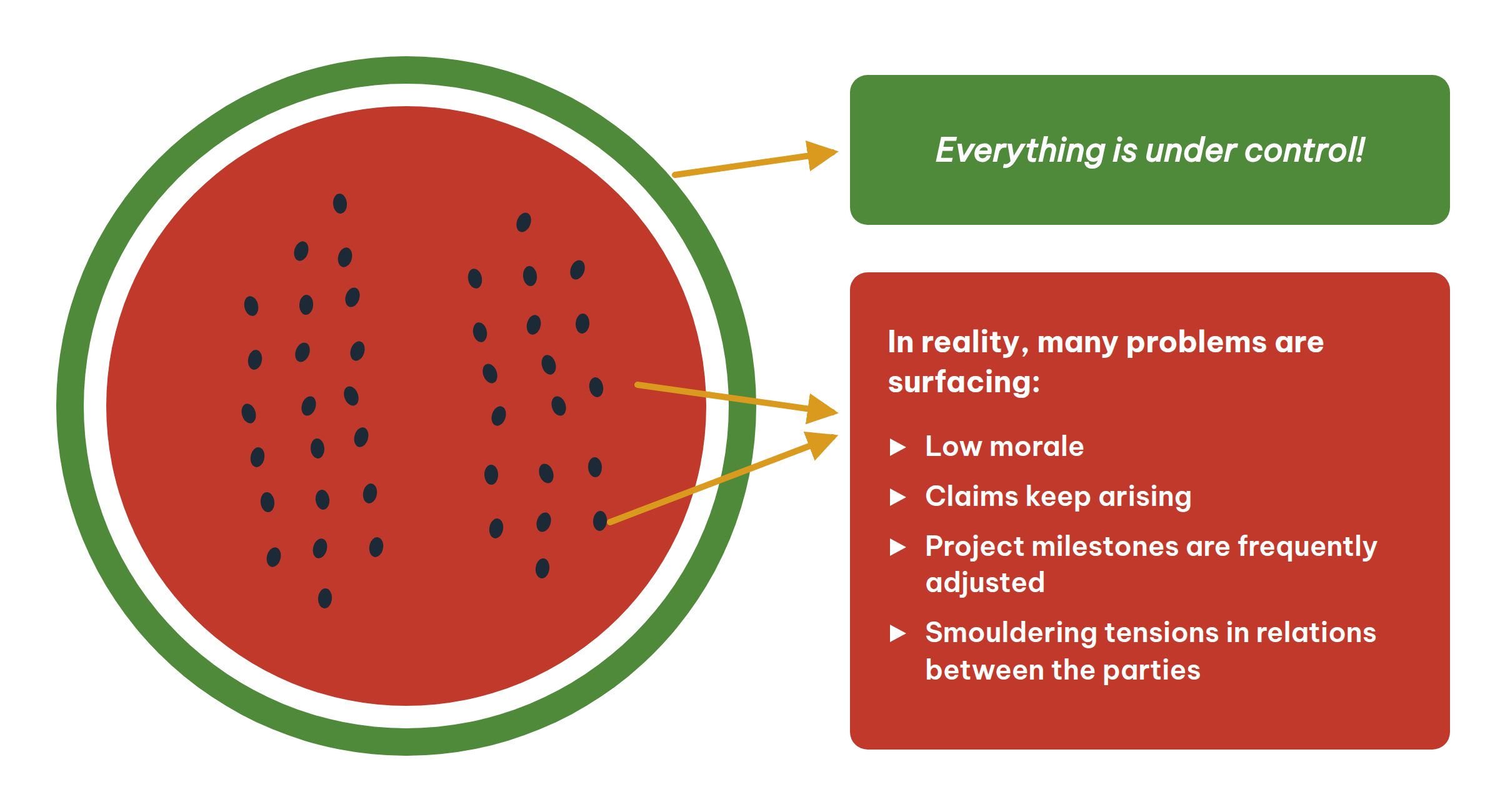
Figure 16.3. The “watermelon effect”: a green rind saying “everything is under control”, a red inside with low morale, frequent changes, constantly adjusted milestones and strained relations between parties.
Right action: acting by the standards
Treat stakeholders kindly, on the basis of understanding and trust; respect and use project resources efficiently; share knowledge and experience to raise colleagues’ working knowledge.
Right livelihood: an honest living from the profession
Practise on your own merit, within the law and professional ethics; do not harm the legitimate interests of others or use authority for personal gain; guard against embezzlement, waste and corruption. The Dhammapada reminds us that purity or impurity depends on oneself; no one can purify another.
Right effort: steadfast in our ideals
Zen Master Thích Nhất Hạnh teaches four practices: do not give negative feelings a chance to arise; calm or replace them when they appear; invite positive seeds into consciousness; and keep wholesome states there as long as possible.
A toxic environment waters the negative seeds. So we build a collaborative, empathetic culture together, commit to the code of ethics and a culture of “no envelopes”; train regularly; meet regularly to see the real situation; and recognise and reward good examples.
Right mindfulness: present here and now
Sitting in a meeting while the mind browses the web, or solving a problem while calculating personal gain or worrying about the future, is not “being present”. As Thích Nhất Hạnh teaches, dwelling in the present does not mean ignoring the past or not planning for the future; it means not losing ourselves in worry. The future is made of the present; taking good care of the present is the best we can do for the future.
Right concentration: focusing on what truly matters
See through the “watermelon” rind to the real state of the project, its root causes and causal relationships. Focus on the problem at hand, not on side issues. Focus on the goals and benefits; methods, tools and techniques are only means, like a ferry that carries us across the river.
| WHAT THE EIGHT PRACTICES BRING
Mastery of body and mind, an upright way of living, happiness in project work whether things go well or badly; peace, stability and clarity. When the whole team practises together, the organisation becomes harmonious, empathetic and collaborative, with the energy to meet every change and setback. |
Apply it to your project
| ONE WEEK OF PRACTICE
☐ Right view: List three things I believe about the project that I have not verified. ☐ Right thought: Before a hard decision, pause for a day and reason with data. ☐ Right speech: The weekly report has a “real issues” section, without window-dressing. ☐ Right mindfulness: In meetings, phone away, no other work. ☐ Right concentration: Each day, name the single most important task for the project’s benefits. |
Reflection questions
| FOR INDIVIDUAL REFLECTION OR GROUP DISCUSSION
1. Is your project “green outside, red inside”? Which indicators would tell you? 2. The last time you reacted hastily to a project problem, would a “pause” have led to a different decision? 3. In project meetings, are you truly “present”? |
Quick check
Question 1. According to Nguyễn Hiến Lê, the whole I Ching comes down to which idea?
- Balance (Trung)
- Rightness (Chính)
- Timeliness (Thời)
- Trust (Tín)
Question 2. What does the “watermelon effect” describe?
- A project with many phases
- Reports that look good outside while serious problems grow inside
- An agricultural project
- Seasonal cost increases
Question 3. Which practice relates to honest communication and active listening?
- Right view
- Right speech
- Right livelihood
- Right effort
Question 4. When the original targets are no longer feasible, the lesson recommends:
- Force schedule recovery at any cost
- Focus on value and benefit for the main stakeholders to find feasible options
- Stop the project immediately
- Keep the targets and wait
Answers and explanations
Question 1: C. Adapt to the moment while keeping Balance and Rightness.
Question 2: B. A green rind of “everything under control” over a red inside of changes, slipping milestones and strained relations.
Question 3: B. Right speech is truthful speech that brings legitimate benefit.
Question 4: B. Focusing on value and benefit widens the room for choosing options.
Key points
| THE ESSENTIALS OF THIS LESSON
• The whole I Ching comes down to Timeliness: adapt to the moment while keeping Balance and Rightness; know when to be firm or gentle, when to advance or withdraw. • When original targets become infeasible, focusing on value and benefit for the main stakeholders opens up more room for choice. • The Noble Eightfold Path offers eight unchanging principles: right view, right thought, right speech, right action, right livelihood, right effort, right mindfulness, right concentration; they interpenetrate, beginning with right view. • The “watermelon effect”: green reports outside, red problems inside. Right speech and right concentration help see through the rind. • The eight practices bring peace, stability and clarity to the individual and harmony to the organisation. |
This lesson is adapted from Chapter 16 of Quản lý dự án: Hiểu đúng & Làm thật (“Project Management: True Understanding, Genuine Action”) by Truong Van Thien (Construction Publishing House, Hanoi, 2025). The content has been condensed and reorganised for learning; full data, quotations and references are in the book.