

PART 3 · CULTURAL ENVIRONMENT
Lesson 4. The elements that shape project management culture
Reading time ≈ 15 min · Based on Chapter 4 of the book
An organisation’s culture is its core identity.
| LEARNING OBJECTIVES
After this lesson you will be able to: • Understand culture as defined by UNESCO and apply it to project organisations. • Describe the six pillars that shape project management culture. • Compare personal values with project values before joining or recruiting. • Explain why a learning organisation needs a shared vision, open dialogue and commitment from leaders to staff. |
Two projects with the same processes and tools can produce very different results. The difference often lies in culture: how people in the organisation think, speak, act and treat one another.
What is culture?
| UNESCO DEFINITION
Culture is the set of distinctive spiritual, material, intellectual and emotional features of society or a social group; it encompasses not only art and literature but also lifestyles, ways of living together, value systems, traditions and beliefs. |
Put simply, culture is the system of material and spiritual values that people create and accumulate through practice, in interaction with their natural and social environment.
The six pillars of project management culture
| COMPASS
Values and purpose Shape the culture. |
LEADS
Leadership qualities and governance style As the leader goes, so goes the culture. |
LIGHTS THE WAY
Professional ethics Guides behaviour and conduct. |
| DRIVES
Developing and using talent Creates cohesion and loyalty. |
DIRECTS
PM methodology Sets how the organisation operates and is run. |
SUSTAINS
Learning and innovation Turns the organisation into a learning environment. |
1. Values and purpose
Project value is the benefit and effectiveness a project brings to its stakeholders: higher revenue, lower cost, better service, a contribution to sustainable development, a stronger national position. These values must be defined, clearly communicated and understood by every member.
Each person also brings their own beliefs and values into the project. So before joining an important project, ask yourself:
- What are my ideals and purpose: income, status, or the chance to contribute and serve?
- Do the project’s purpose and mission fit those aspirations?
| Values aligned
We find motivation, enthusiasm and happiness in project work. |
Values in conflict
We bring negative energy into the project through biased or self-interested behaviour and decisions. |
Organisations, in turn, should check whether candidates’ values and goals fit the shared ones before selecting them.
2. Leadership qualities and governance style
Thin in virtue yet high in rank, small in wisdom yet planning great affairs, weak in strength yet shouldering heavy loads: such people rarely succeed, and endanger themselves and others.
— Nguyễn Duy Cần, Dịch học nhập môn (An Introduction to the I Ching)
When forming a project organisation, the first task is to find the right people for key positions: the project director (for simple projects) or a management board (for large, complex ones). They lead the culture through their qualities, beliefs, thinking and behaviour.
3. Professional ethics
On many successful projects, the leaders’ responsibility, respect, fairness and integrity form the nucleus around which everyone unites. Organisations should:
- Issue professional ethical standards and rules, with everyone from leaders to staff committing to them.
- Monitor and enforce them, so that ethical duty stays constantly in mind.
4. Developing and using talent
Raise the virtuous and employ the talented, and every day brings advantage… The timing of heaven is not as good as the advantage of terrain; the advantage of terrain is not as good as the harmony of people.
— Trần Hưng Đạo, Binh thư yếu lược (Essentials of Military Strategy)
How an organisation uses people decides whether its environment is cohesive and whether trust is well placed. To attract and unleash talent we need a culture of respect and empathy; when talented people stay, they reinforce that culture.
5. The chosen PM methodology
A methodology is the system of principles, practices, processes and methods used to manage projects. It shapes how the organisation is run, how work is done and how issues are handled. (Details in Lesson 8.)
6. Learning and innovation
Every project and phase brings new challenges and opportunities, with no ready formula. Organisations need mechanisms to encourage learning and to carry lessons from phase to phase and project to project.
If everyone follows personal preferences, or only orders and rank, there is no learning culture. A learning organisation needs a shared vision, open dialogue, transparent information, agreed solutions and committed execution from leaders to staff.
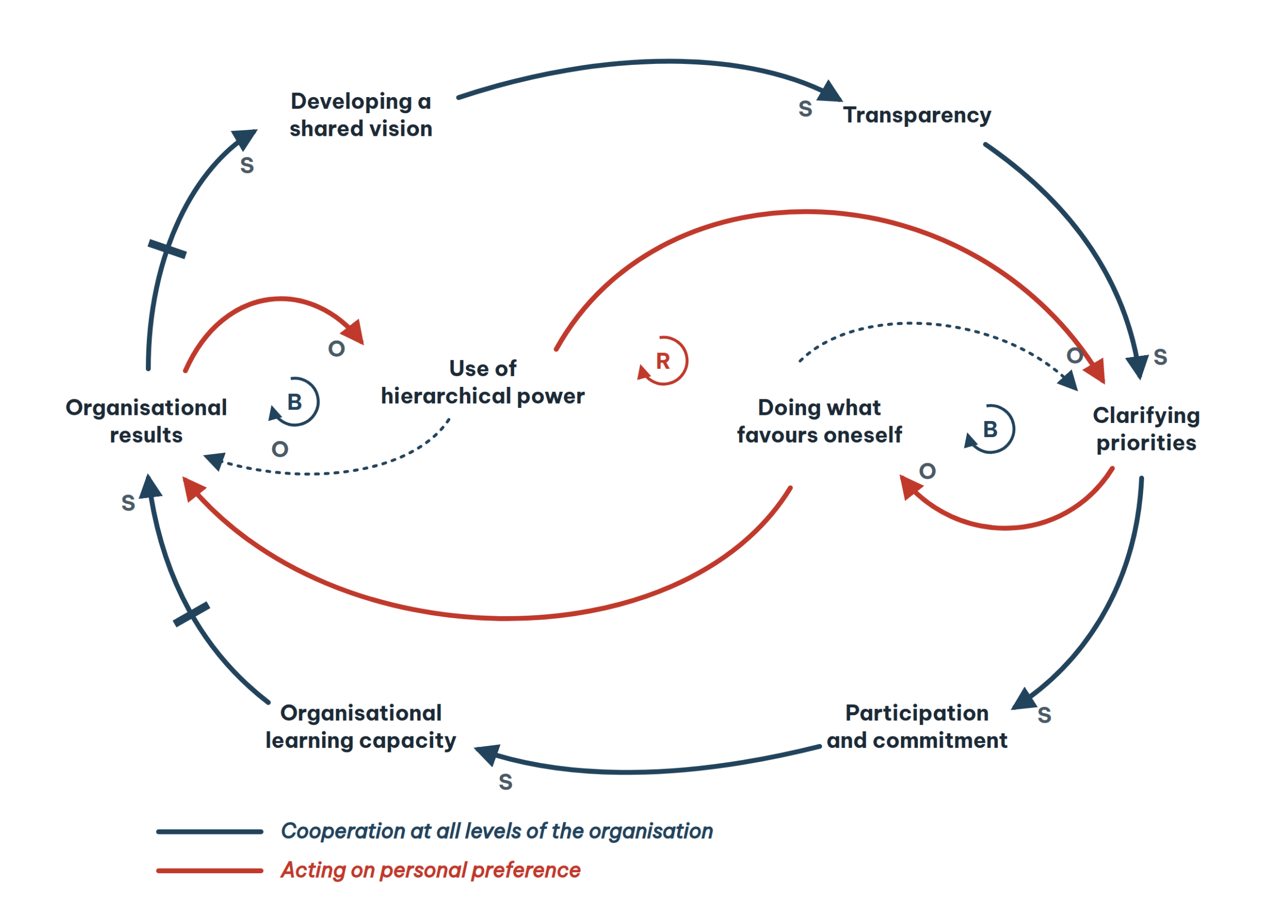
Figure 4.2. Developing a learning project organisation, seen through systems thinking. “S” links move in the same direction, “O” links in opposite directions; “R” is a reinforcing loop, “B” a balancing loop. Cooperation (blue) strengthens learning capacity; acting on personal preference and hierarchical power (red) holds it back.
| REMEMBER
The six pillars are causally linked and influence each other. But the qualities, behaviour and example of the project leader decide what “kind” of culture takes shape in the organisation. |
Apply it to your project
| A QUICK CHECK OF THE SIX PILLARS
☐ The project’s values and purpose are written down and every member can repeat them. ☐ Project leaders were chosen for qualities and competence suited to the type of project. ☐ A code of professional ethics has been issued and signed. ☐ There is a plan to retain and develop talent after the project ends. ☐ The PM methodology was chosen deliberately and is applied consistently. ☐ Lessons learned are captured regularly, not only at project close. |
Reflection questions
| FOR INDIVIDUAL REFLECTION OR GROUP DISCUSSION
1. Have the values and purpose of your current project been clearly communicated to every member? Could you state them in one sentence? 2. Do your personal ideals align or conflict with the project’s values? How does that affect your energy at work? 3. Which of the six pillars is weakest in your organisation? |
Quick check
Question 1. Which pillar acts as the “compass” that shapes project culture?
- PM methodology
- The organisation’s values and purpose
- Talent development
- Learning and innovation
Question 2. What happens when personal values conflict with project values?
- Nothing, if the person is technically strong
- The person brings negative energy into the project through behaviour and decisions
- The project adjusts to that person
- The person works harder
Question 3. According to the lesson, what decides the “kind” of culture an organisation develops?
- ISO procedures
- Project management software
- The leader’s qualities, behaviour and example
- Headcount
Answers and explanations
Question 1: B. Values and purpose are the compass; leadership leads; ethics lights the way; talent drives cohesion; methodology directs; learning sustains.
Question 2: B. Conflicting values lead to biased or self-interested behaviour and decisions that affect the shared environment.
Question 3: C. The six pillars interact, but leadership is decisive.
Key points
| THE ESSENTIALS OF THIS LESSON
• Culture is the system of material and spiritual values that people create and accumulate through practice; for an organisation, it is its core identity. • Six pillars: values and purpose; leadership qualities and governance style; professional ethics; developing and using talent; the chosen PM methodology; learning and innovation. • When personal values align with project values, we find motivation; when they conflict, we bring negative energy into the project. • The qualities, behaviour and example of the project leader decide what “kind” of culture takes shape. |
This lesson is adapted from Chapter 4 of Quản lý dự án: Hiểu đúng & Làm thật (“Project Management: True Understanding, Genuine Action”) by Truong Van Thien (Construction Publishing House, Hanoi, 2025). The content has been condensed and reorganised for learning; full data, quotations and references are in the book.