


PART 7 · ADAPTIVE, VALUE-FOCUSED MANAGEMENT
Lesson 17. Proactive stakeholder engagement
Reading time ≈ 16 min · Based on Chapter 17 of the book
Know the enemy and know yourself, and in a hundred battles you will not be in peril;
know yourself but not the enemy, and you will win one and lose one;
know neither, and you will be in peril in every battle.
— Sun Tzu
| LEARNING OBJECTIVES
After this lesson you will be able to: • Recognise the typical challenges when “interested parties” intervene in a project. • Identify stakeholders with a set of questions and common methods. • Analyse and prioritise stakeholders using matrices or scoring. • Build trust (“a token of faith”) and engage each stakeholder group proactively. |
Managing “interested parties” is complex and sensitive. Their roles shift from phase to phase, and their views and demands differ widely. When someone with power does not share the project’s purpose, the result can be a “disaster”.
Lessons from “Pity the People’s Money”
| A SUMMARY OF AZIZ NESIN’S SHORT STORY
Nine years to build a hotel A hotel is launched with great fanfare. Then every visiting delegation of officials makes a new demand, each time in the name of “pity the people’s money”: the corridors are too narrow, so there must be more and wider ones (and the first contractor is dismissed); the lounges are as big as a racecourse, so they are shrunk; there must be domes in the Turkish style; then there are too many corridors; there must be tiles; a lounge without columns “will surely collapse”, so columns are added; square columns must become round; the façade must be glass; the stairs are too steep. The entourage nods every time. Nine years later the building is a jumble of every style, and the project chief proudly declares how much of the people’s money they saved. |
The humour exposes an age-old problem between those who talk and those who do. Binh thư yếu lược already noted: one person advises, another does the work; the adviser does not know how hard the work is; one person works while dozens talk, the worthy and the crooked mixed together; the favoured one’s poor plan is followed, the disliked one’s good plan is blocked.
| Shifting roles
Stakeholders come and go through each phase. |
Divergent demands
Very different views, perceptions and wishes. |
| Power without vision
“An official’s word is iron”, and juniors simply comply. |
Crowd effects
Sometimes used to pressure the project into change. |
Identifying stakeholders
Questions that help find them:
- Who can directly affect the project’s objectives?
- Who can contribute important resources?
- Who could obstruct or delay the project?
- Who can provide independent expert opinion?
- Who can remove obstacles?
- Who can help improve project performance?
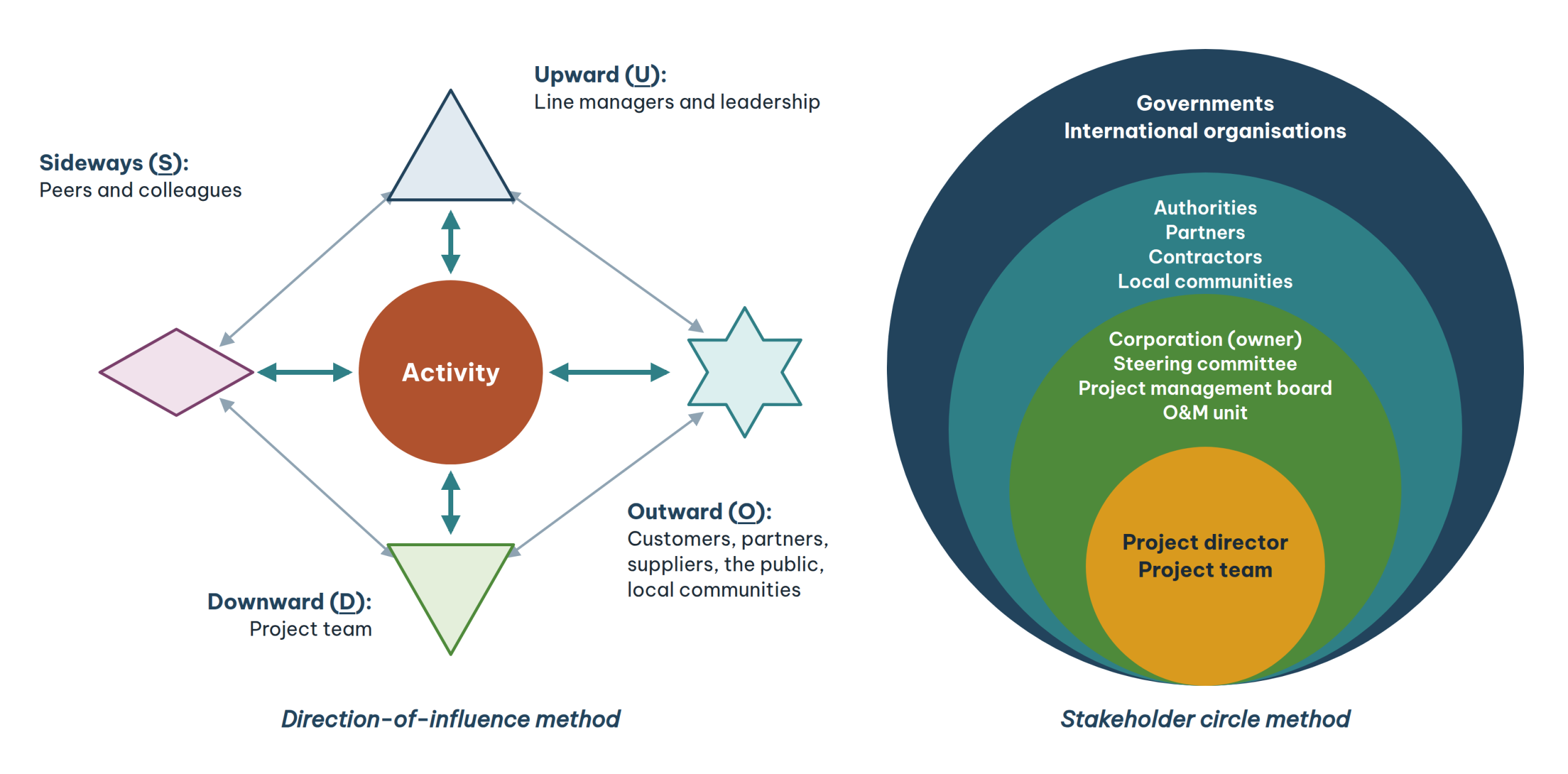
Figure 17.2. Two common methods: direction of influence (upward: management and leadership; downward: the project team; outward: customers, partners, suppliers, communities; sideways: peers) and concentric circles from the project team out to government and international organisations.
Analysing and prioritising
Depending on the project and phase, you can use:
| Tool | Axes or criteria |
| Help–harm matrix | Ability to help the project × ability to harm it |
| Influence–interest matrix | Influence on the project × interest in or benefit from it |
| Scoring | Power (authority over the project), urgency (readiness to act, scope of impact), proximity (close and frequent, or distant and indirect) |
| ALWAYS REMEMBER
Stakeholders are people, so they always change: perceptions, attitudes, involvement, positions, authority, expected benefits and commitment. The analysis must be updated regularly. |
Building trust: “a token of faith”
In The Tale of Kiều, Nguyễn Du’s heroine gives her beloved a keepsake as a “token of faith” (của tin) to seal a lifelong promise. On projects, a token of faith is the trust, regard and commitment we give each other. With it:
- Communication is effective, with full and timely information.
- Discussion is open and consultation frequent.
- We listen and compromise.
- We agree common ground and the criteria for judging whether the project succeeds.
Proactive engagement
Trust between the project organisation and its stakeholders depends mainly on the words and behaviour of its leader. As the leader behaves, so do the staff; and stakeholders look at the leader to picture the whole organisation.
- Set the example: Words and behaviour that follow the code of ethics and core values.
- Know the project: Vision, mission, goals and plans, to communicate transparently and adapt.
- Engage by priority: Match the level of interaction to each stakeholder’s priority.
- Speak up proactively: Classify major issues in advance so you are ready to speak when they arise.
- Action over promises: Focus on commitments that are delivered.
Engaging stakeholders on a foundation of trust maximises the chances of success, supports effective decisions, reduces risk and builds lasting partnerships.
Apply it to your project
| MAP YOUR STAKEHOLDERS IN 30 MINUTES
☐ List stakeholders in four directions: up, down, out and sideways. ☐ Score each for power, urgency and proximity. ☐ Choose the top five and note an engagement approach, an owner and a frequency. ☐ Identify sensitive issues that need prepared messages. ☐ Review the promises made and whether they have been kept. |
Reflection questions
| FOR INDIVIDUAL REFLECTION OR GROUP DISCUSSION
1. Who has the most power over your project but does not yet share its vision? What is your approach to them? 2. Which design changes on your project came from personal opinion rather than legitimate requirements? 3. Which recent promise by your organisation to a stakeholder has not been kept? What did it do to trust? |
Quick check
Question 1. What is the main lesson of “Pity the People’s Money”?
- Use many architectural styles
- Whimsical intervention by powerful people who do not share the project’s purpose causes rework, delay and cost
- Change contractors often
- Save money at any cost
Question 2. The three criteria in the stakeholder scoring method are:
- Age, position, income
- Power, urgency, proximity
- Budget, schedule, quality
- Number, location, language
Question 3. According to the lesson, trust between the project organisation and stakeholders depends mainly on:
- Tight contracts
- The words and behaviour of the project organisation’s leader
- Project software
- The number of meetings
Answers and explanations
Question 1: B. Each demand made in the name of “pity the people’s money” stretched the project to nine years and wasted money.
Question 2: B. Power over the project, readiness to act, and closeness of the relationship.
Question 3: B. Stakeholders look at the leader to picture the whole organisation.
Key points
| THE ESSENTIALS OF THIS LESSON
• Aziz Nesin’s story “Pity the People’s Money” shows what happens when powerful people who do not share a project’s purpose keep intervening: rework, delay and cost. • Identify stakeholders by asking who affects the objectives, contributes resources, could obstruct, can give independent advice, can remove obstacles or improve performance. • Analyse with matrices (help–harm; influence–interest) or score power, urgency and proximity. • Stakeholders are people, so they always change; what does not change is the need to build trust. • The project organisation’s leader is the model: knows the vision, mission and goals; speaks up proactively; values action over promises. |
This lesson is adapted from Chapter 17 of Quản lý dự án: Hiểu đúng & Làm thật (“Project Management: True Understanding, Genuine Action”) by Truong Van Thien (Construction Publishing House, Hanoi, 2025). The content has been condensed and reorganised for learning; full data, quotations and references are in the book.