


PART 5 · BUILDING THE ORGANISATION
Lesson 12. Building a cohesive project team
Reading time ≈ 20 min · Based on Chapter 12 of the book
Do not promote officials like pounding rice…
An official raised up and dropped down three times is ruined for life.
— President Hồ Chí Minh
| LEARNING OBJECTIVES
After this lesson you will be able to: • Select team members for capability and shared values. • Inspire and motivate through example and sincere recognition. • Choose a structure (matrix or projectised) and build a RACI matrix correctly. • Set realistic deadlines using traditional or agile estimating. • Propose a career path that retains project talent. |
A project leader cannot deliver the project alone. This lesson is about gathering, leading and keeping a cohesive team.
The right people in the right roles
| STORY
Shackleton’s notice The explorer Ernest Shackleton is said to have recruited for his Antarctic expedition with a notice: “Men wanted for hazardous journey. Low wages, bitter cold, long hours of complete darkness. Safe return doubtful. Honour and recognition in event of success.” Only those who truly believed in themselves applied. The expedition met extraordinary disasters and spent 22 months on the ice, yet all 28 men came home. (As told in Thinking Good by Inamori Kazuo.) |
For large projects of national importance, we should “recruit” in that spirit to gather people devoted to a shared ideal. Typical roles: project coordination, engineering and technology, commercial, contracts and procurement, finance, site management, quality, health, safety and environment, plus engineers and support staff.
Criteria: capability and experience; shared values; the same ambition to contribute; enthusiasm and positive energy. Choosing the right person is necessary; trusting them and giving matching duties and authority is what makes it sufficient.
Inspiring and motivating
- Set an example of benevolence, righteousness, trustworthiness, wisdom, clarity, talent, firmness and discipline, and earn standing.
- Genuinely value the team, be tolerant, and keep positive energy every day.
- Help staff believe in their own abilities.
- Listen, judge work objectively, and praise results sincerely, small or large.
- Be humble, own your mistakes; help staff see theirs so they can improve.
Clear responsibilities
Who does what, who coordinates, who approves, with what resources, by when? Three tools answer this: the organisation breakdown structure (OBS), the RACI matrix and the schedule.
Two common OBS models
| Matrix structure
Suits organisations that run many projects continuously. Project teams are formed from functional departments on time-limited assignments. |
Projectised structure
Suits large, complex projects that mobilise many resources, such as industrial, infrastructure and energy projects. |
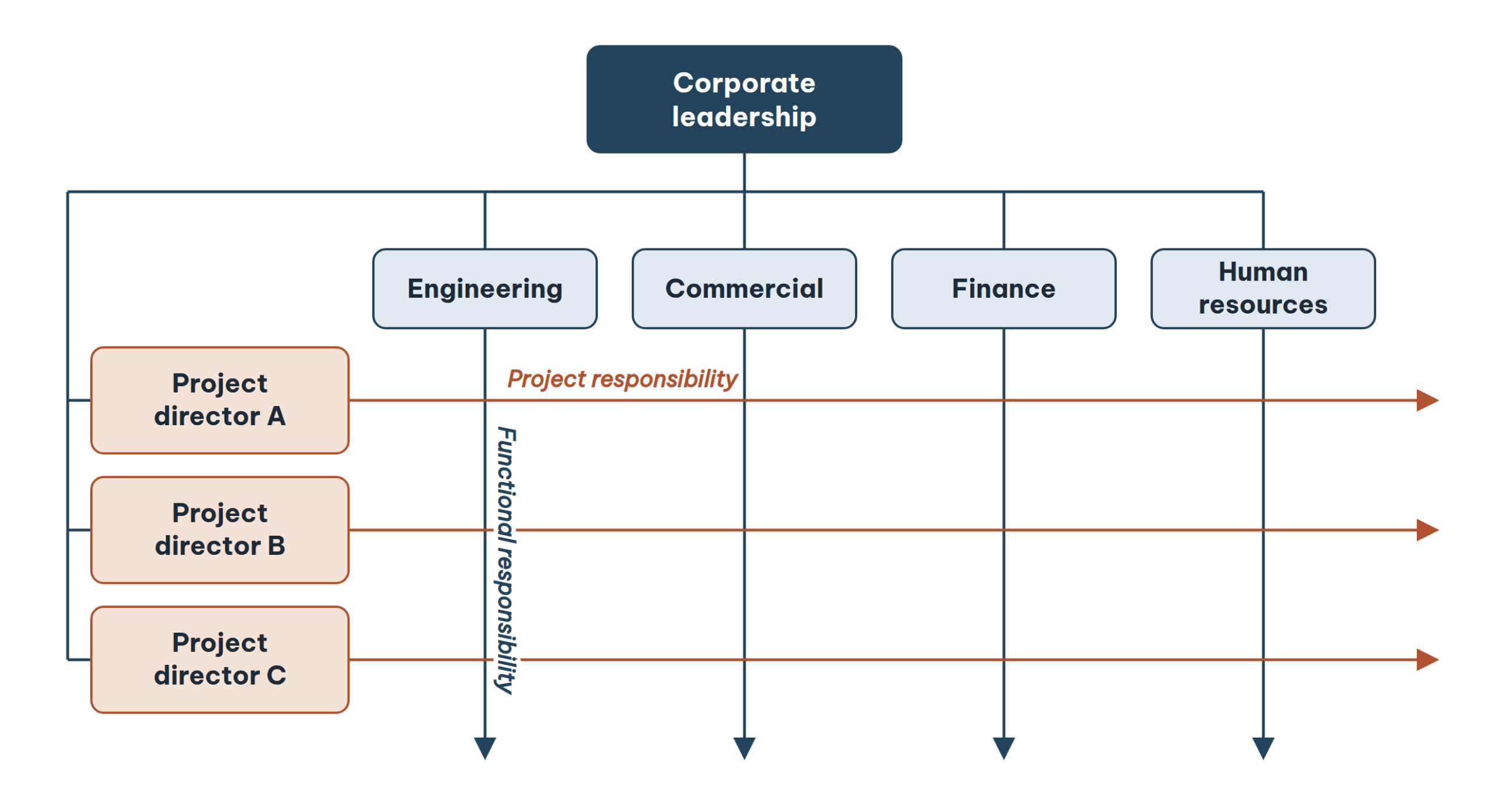
Figure 12.1. The matrix structure.
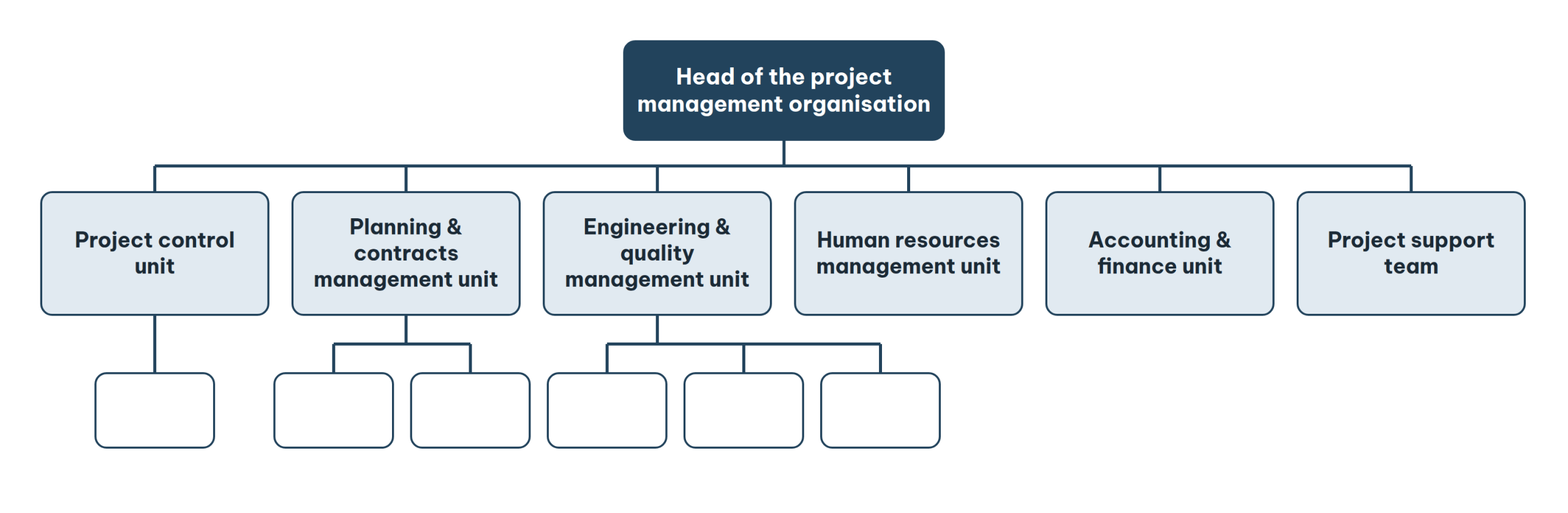
Figure 12.2. The projectised structure.
The RACI matrix
The OBS is linked to the WBS, tying each unit or person to specific work items. The RACI matrix clarifies the level of involvement:
| R · RESPONSIBLE
Does the work Directly produces the product or service. |
A · ACCOUNTABLE
Answers for it Decides, approves, ensures the work is done. |
| C · CONSULTED
Gives advice Asked for technical or management input. |
I · INFORMED
Kept informed Told about progress and results. |
An illustrative example for some tasks on a power plant project:
| Task | Project director | Engineering | Contracts | Finance | Site | Due |
| Approve the EPC tender documents | A | R | R | C | I | M3 |
| Review the basic design | I | A/R | I | – | C | M5 |
| First payment to the contractor | A | C | R | R | C | M6 |
| Site safety plan | I | C | – | – | A/R | M7 |
| RACI RULE
Every task must have exactly one A and at least one R. Add deadlines or milestones to the matrix, and keep the OBS and RACI up to date throughout the project. |
Realistic deadlines
Realistic deadlines come from a feasible schedule, built with methods that fit the chosen methodology.
| TRADITIONAL
Absolute estimating Gantt, critical path, PERT, combined with expert judgement and analogous, parametric and three-point estimating. |
AGILE
Relative estimating Measured in story points: T-shirt sizes (S, M, L, XL), the Fibonacci sequence (1, 2, 3, 5, 8, 13…) or planning poker. Agree an “average” size, then compare larger or smaller. |
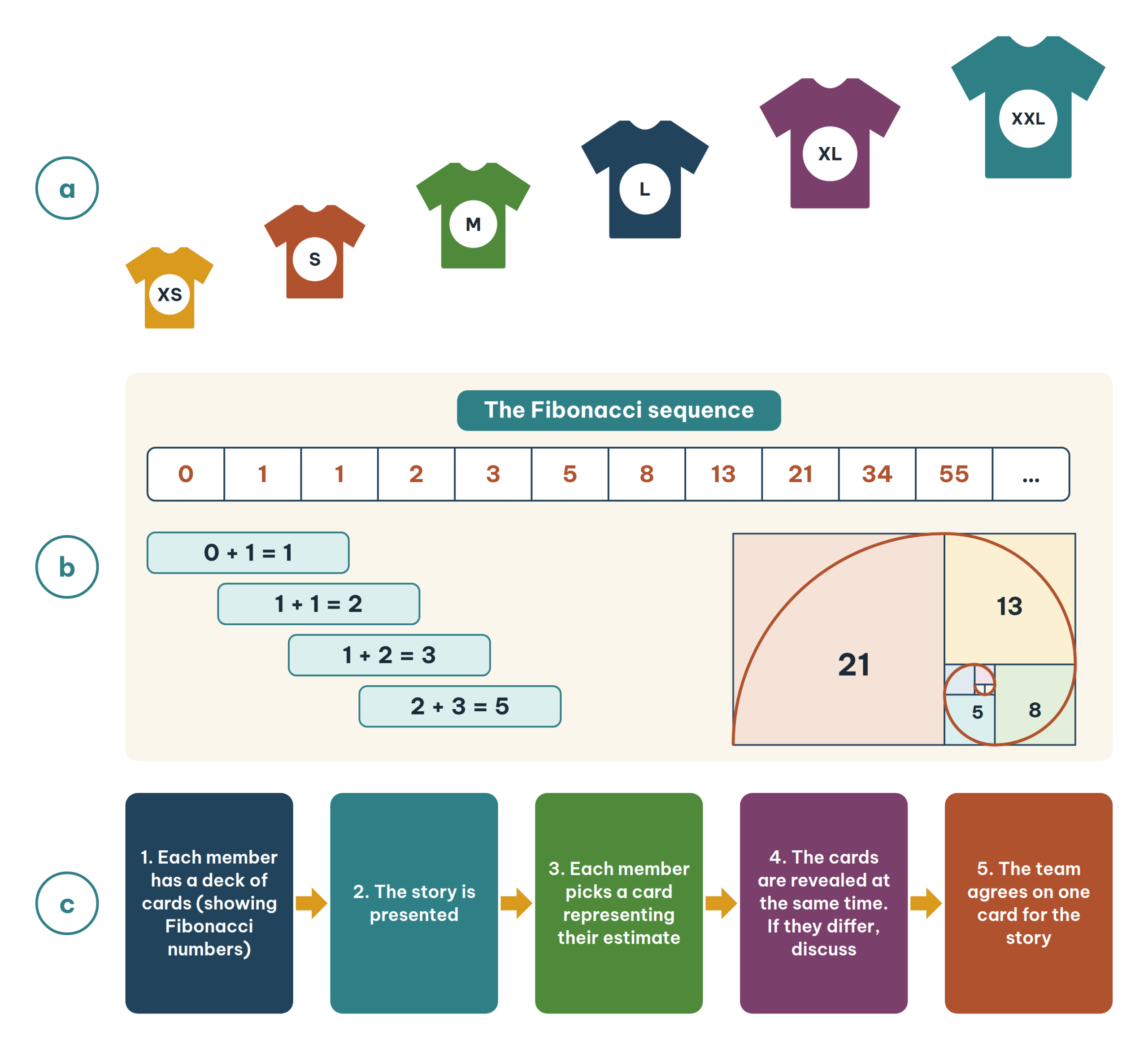
Figure 12.5. Estimating techniques: a) T-shirt sizes; b) the Fibonacci sequence; c) planning poker.
In Agile, each Sprint is scheduled at the sprint planning meeting, based on the team’s actual velocity in the previous cycle.
Using and retaining project talent
Project work is temporary. Without a strategy for using people and a career path, good people leave after the project. The next project forms a new organisation of new people who repeat old mistakes: the organisation pays “tuition” many times for the same lesson.
Effective talent management means respecting and valuing the people who work with you; placing the right person, with the right strengths, at the right time; paying fairly so they can serve with integrity; and offering a clear career path.
A reference career path
- Entry: Discipline engineer, project officer.
- Intermediate: Project coordinator or assistant PM; or specialist, site manager, engineering manager.
- Project manager: Project director.
- Senior: Senior project director, programme director.
- Strategic: Portfolio director, or business leadership.
Apply it to your project
| REVIEW YOUR TEAM
☐ Every member knows their R/A/C/I role for the main tasks. ☐ No task has two “A”s or lacks an “R”. ☐ Deadlines are estimated with the team, not only imposed from above. ☐ Contributions are recognised and praised regularly. ☐ Each key person knows their next career step after the project. |
Reflection questions
| FOR INDIVIDUAL REFLECTION OR GROUP DISCUSSION
1. If you wrote a Shackleton-style “recruitment notice” for your project, what would it say? 2. On your current project, is there any task with two “A”s or no “R”? 3. When the project ends, where will the best people on your team go? What is your organisation’s plan? |
Quick check
Question 1. The basic rule when building a RACI matrix is:
- Each task has at least two A’s
- Each task has exactly one A and at least one R
- The project director is always R
- Everyone is C
Question 2. Which structure suits a large power plant project?
- Matrix
- Projectised
- Purely functional
- No structure needed
Question 3. In Agile, the story points planned for a Sprint are based on:
- Orders from above
- The team’s actual velocity in the previous cycle
- The total budget
- Contracted working hours
Answers and explanations
Question 1: B. Exactly one accountable person and at least one responsible person.
Question 2: B. The projectised structure suits large, complex projects that mobilise many resources.
Question 3: B. Team velocity from the previous cycle (or experience, for the first cycle) is the basis.
Key points
| THE ESSENTIALS OF THIS LESSON
• Choose people who have the capability and share the values and ambition; trust and appropriate authority complete the choice. • Leaders inspire by example, by valuing the team, by listening and sincere praise, and by owning their mistakes. • A matrix structure suits organisations running many projects continuously; a projectised structure suits large, complex industrial, infrastructure and energy projects. • The OBS links to the WBS; in a RACI matrix every task has exactly one A and at least one R. • Realistic deadlines come from a feasible schedule: Gantt, critical path and PERT traditionally; story points, Fibonacci, planning poker and team velocity in agile. • Without a strategy to retain talent, an organisation pays “tuition” many times for the same lesson. |
This lesson is adapted from Chapter 12 of Quản lý dự án: Hiểu đúng & Làm thật (“Project Management: True Understanding, Genuine Action”) by Truong Van Thien (Construction Publishing House, Hanoi, 2025). The content has been condensed and reorganised for learning; full data, quotations and references are in the book.