


PART 7 · ADAPTIVE, VALUE-FOCUSED MANAGEMENT
Lesson 19. Managing troubled projects
Reading time ≈ 22 min · Based on Chapter 19 of the book
Our greatest weakness lies in giving up.
The most certain way to succeed is always to try just one more time.
— Thomas Edison
| LEARNING OBJECTIVES
After this lesson you will be able to: • Learn from two major troubled projects that were recovered: Sydney Opera House and Vogtle 3&4. • Explain why early detection greatly reduces the cost and time of recovery. • Check project health across 5 groups and 15 criteria. • Recognise the signs that a project is in trouble. • Propose an approach to project recovery. |
Troubled projects are not rare. What matters is whether trouble is spotted early or late, and how recovery is handled. The two international stories below show that failing on schedule and cost is not the end.
Two stories
| STORY 1
Sydney Opera House In 1956 the state of New South Wales held a design competition; the young Danish architect Jørn Utzon won with his shell design, amid much public criticism. Fearing that opponents would derail the project, the Premier pushed for an early start (March 1959) before the design was complete and while major structural questions were unresolved. The original estimate: AUD 7 million, finishing January 1963. The foundations met weak ground, required 550 reinforced-concrete piles, and were finished only in January 1963. The shell roofs had to be redesigned for acoustic, thermal and structural reasons. Labour disputes, design changes and price rises drove costs up. In 1965 a new government tightened costs and withheld payments; Utzon resigned and left Australia. A new team of architects redid the interiors, and much work had to be demolished. It opened on 20 October 1973: 14 years instead of 4, AUD 102 million, over 14 times the estimate. Today it is a symbol of modern Australia and a World Heritage site. |
| STORY 2
Vogtle 3 & 4 nuclear plant (USA) In 2008 Georgia Power signed an EPC contract with Westinghouse and The Shaw Group for two AP1000 reactors of about 1,200 MW each, the first new US nuclear build in around 30 years. The plan: about USD 14 billion, completion in 2017. The shield building had to be redesigned; the licence was challenged in court after Fukushima; only in March 2013 was the reactor basemat poured, with more than 9,000 workers on site. Cost growth and long delays led Westinghouse to file for bankruptcy in March 2017, and the owner took over the project. Unit 3 entered commercial operation in July 2023 and Unit 4 in April 2024: 7 years late, about USD 32 billion, more than double the estimate. Vogtle is now a source of clean Generation III+ power, supporting net-zero goals and the state’s economic growth. |
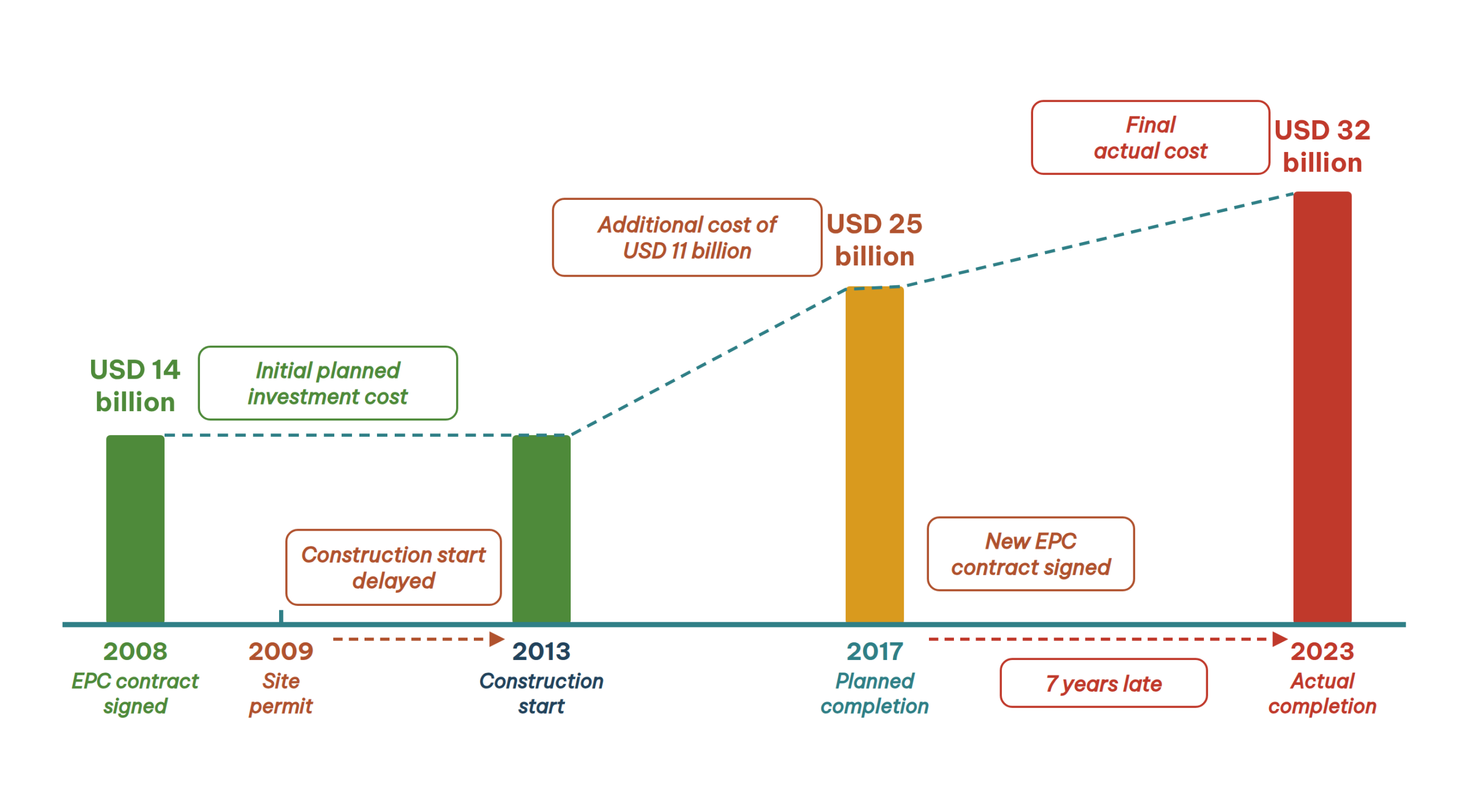
Figure 19.4. Cost growth and schedule delay at Vogtle 3 & 4.
Both projects fell into crisis and missed their original targets, yet both were recovered. Sydney also shows the effect of “blindly optimistic” cost and schedule planning.
Early detection: prevent it before it appears
What is still is easy to hold; what has not yet shown itself is easy to plan for; what is soft is easy to break; what is small is easy to scatter. Prevent it before it appears; put it in order before disorder sets in.
— Cited in the book from the I Ching; the same words appear in the Tao Te Ching , chapter 64
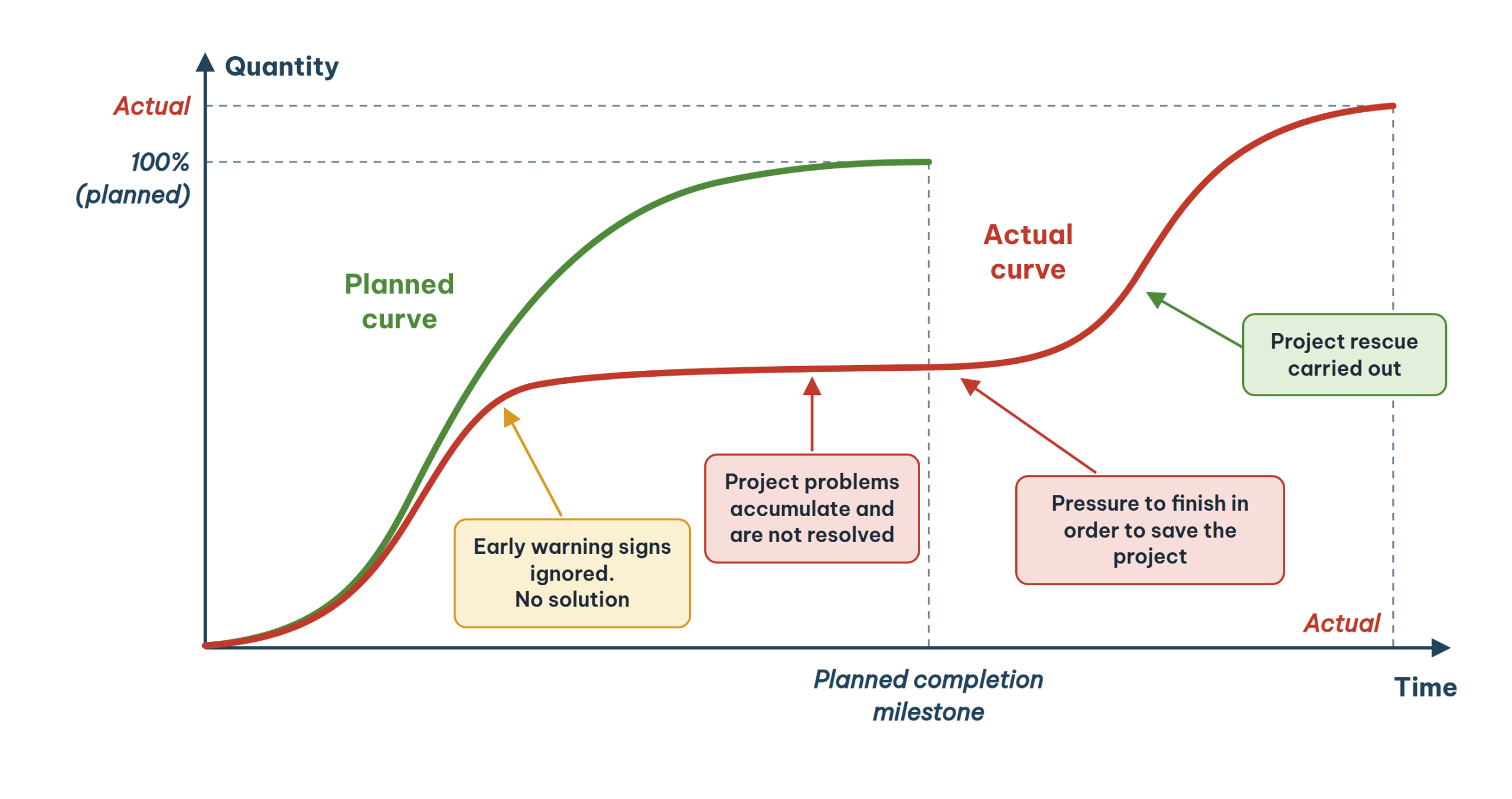
Figure 19.6. Quantity–time.
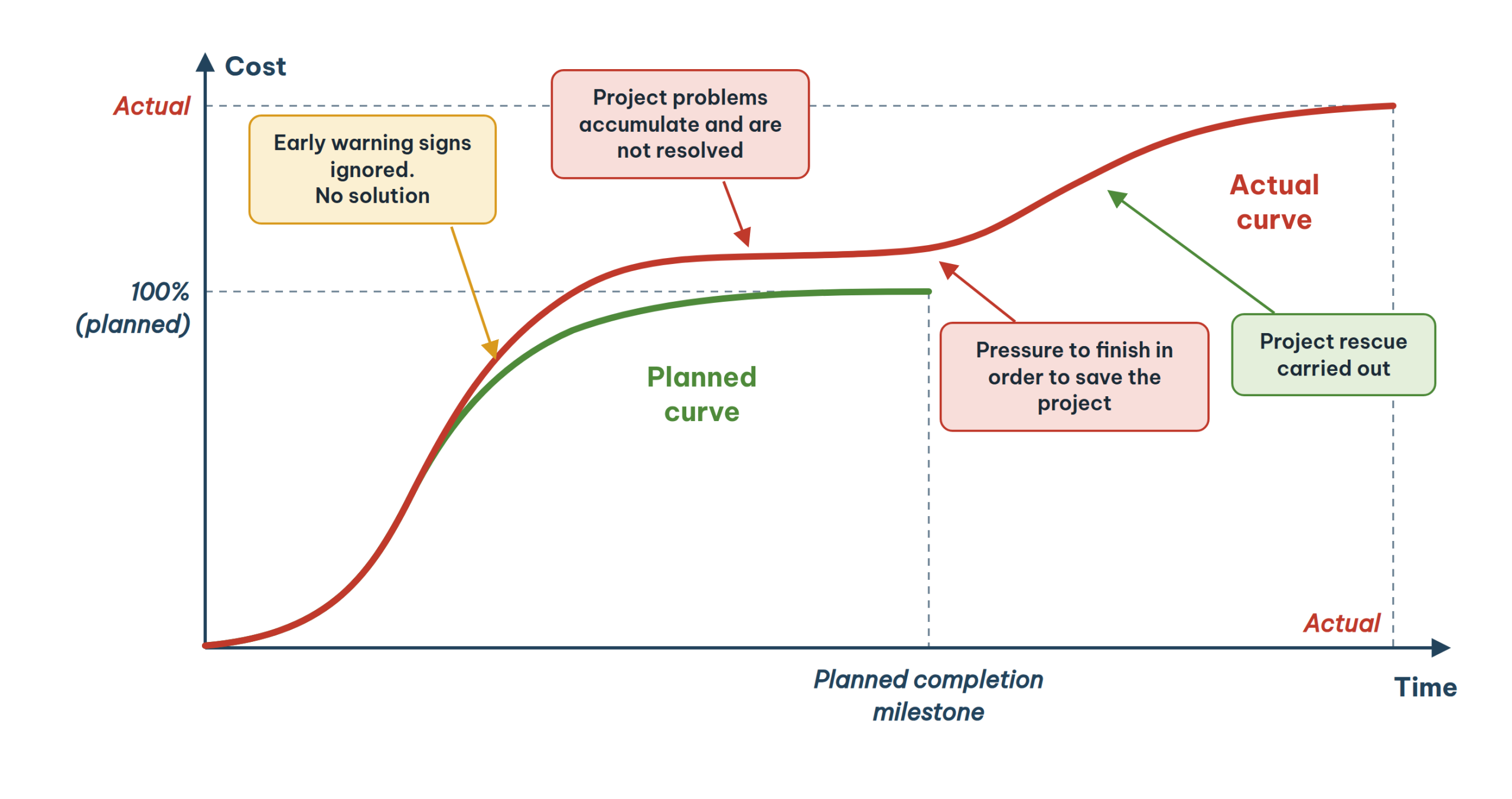
Figure 19.7. Cost–time.
When early warnings are ignored, problems accumulate; by the time recovery is unavoidable, the schedule stretches and costs grow far beyond what an early fix would have cost.
Checking project health
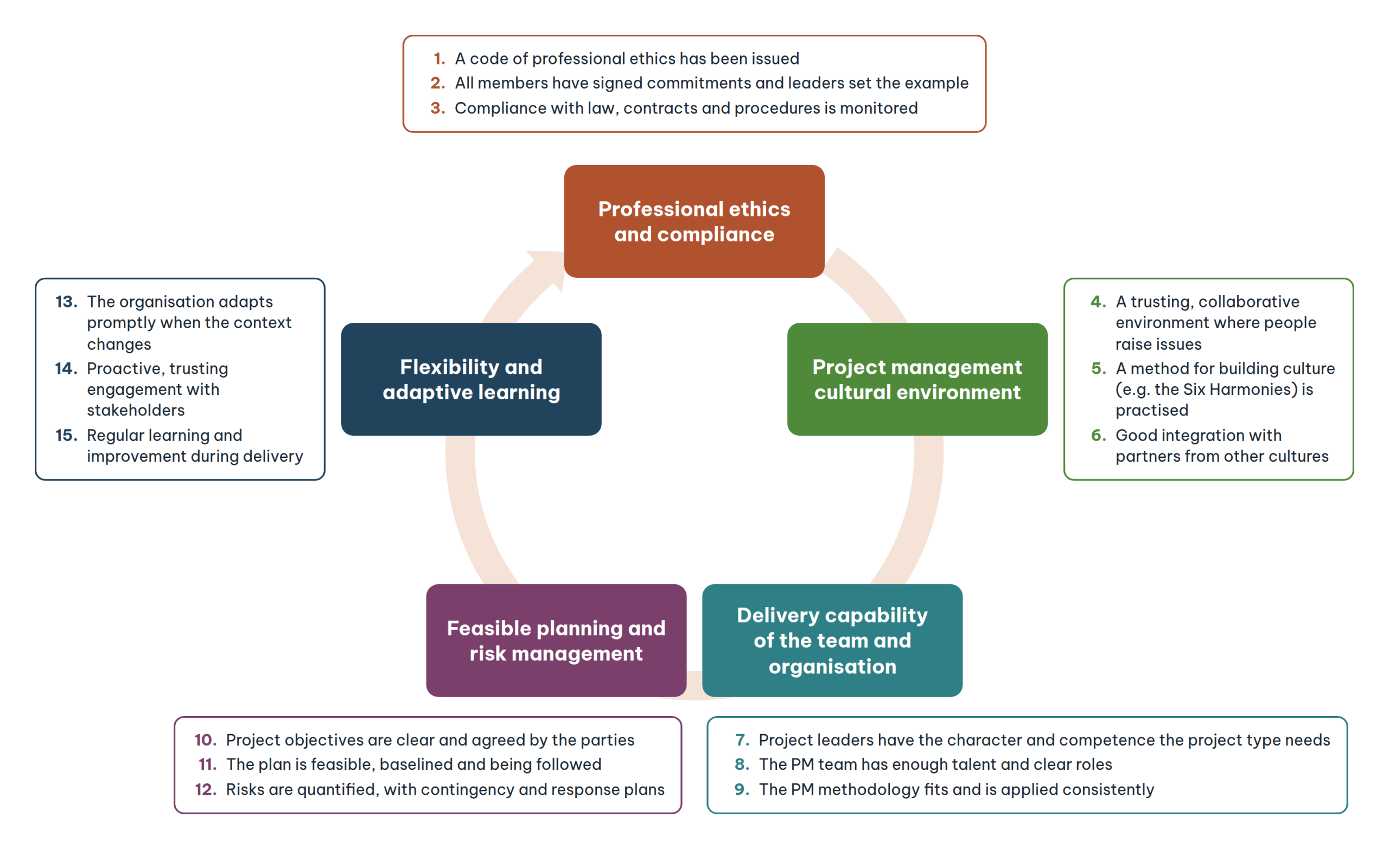
Figure 19.8. Five groups and fifteen criteria for checking the health of the project and its organisation.
Steps: define scope, objectives and criteria → collect data → analyse strengths, weaknesses, opportunities and threats → report the current state, trends and recommendations → discuss with the project organisation to reach shared understanding → follow up on the recommendations.
Methods: document review, interviews, surveys, observation, EVM, risk and impact matrices. A health check should be done regularly and by an independent party. Benefits: early detection, better performance, a basis for decisions, clear accountability, proactive risk management, optimised resources, assured compliance, more trust and more learning.
HEALTH CHECK FORM
Quick project health check
Score each criterion: 0 absent or very weak · 1 weak · 2 fair · 3 good. This is a quick self-assessment and does not replace an independent review. Results are stored only in your browser.
| Criterion | 0 | 1 | 2 | 3 |
| ETHICS AND COMPLIANCE | ||||
| 1. A code of professional ethics has been issued | ☐ | ☐ | ☐ | ☐ |
| 2. All members have signed commitments and leaders set the example | ☐ | ☐ | ☐ | ☐ |
| 3. Compliance with law, contracts and procedures is monitored | ☐ | ☐ | ☐ | ☐ |
| CULTURAL ENVIRONMENT | ||||
| 4. A trusting, collaborative environment where people raise issues | ☐ | ☐ | ☐ | ☐ |
| 5. A method for building culture (e.g. the Six Harmonies) is practised | ☐ | ☐ | ☐ | ☐ |
| 6. Good integration with partners from other cultures | ☐ | ☐ | ☐ | ☐ |
| DELIVERY CAPABILITY | ||||
| 7. Project leaders have the character and competence the project type needs | ☐ | ☐ | ☐ | ☐ |
| 8. The PM team has enough talent and clear roles | ☐ | ☐ | ☐ | ☐ |
| 9. The PM methodology fits and is applied consistently | ☐ | ☐ | ☐ | ☐ |
| PLANNING AND RISK | ||||
| 10. Project objectives are clear and agreed by the parties | ☐ | ☐ | ☐ | ☐ |
| 11. The plan is feasible, baselined and being followed | ☐ | ☐ | ☐ | ☐ |
| 12. Risks are quantified, with contingency and response plans | ☐ | ☐ | ☐ | ☐ |
| FLEXIBILITY AND LEARNING | ||||
| 13. The organisation adapts promptly when the context changes | ☐ | ☐ | ☐ | ☐ |
| 14. Proactive, trusting engagement with stakeholders | ☐ | ☐ | ☐ | ☐ |
| 15. Regular learning and improvement during delivery | ☐ | ☐ | ☐ | ☐ |
Scoring: add the scores in each group and divide by the maximum (number of criteria × 3). 70% or more: good; 45–69%: needs improvement; below 45%: priority for action.
Signs a project is in trouble
| Area | Signs (Table 19.1) |
| Progress | Disbursement below plan; related sub-projects halted; the actual S-curve falls below and drifts further from the plan. |
| Communication and relationships | Pressing issues are not raised at reviews; parties disagree on how to assess problems and solutions; relationships deteriorate fast. |
| Cost | The forecast cost at completion exceeds the approved total investment. |
| Schedule | No completion date backed by a feasible schedule; key milestones late against plan. |
| Scope | Requirements are constantly proposed for change; parties disagree on parts of the scope. |
| Quality | Non-conformances rise sharply without control measures. |
| Resources | Suitable people cannot be assigned; a tense, low-trust environment; members do not understand the real nature of the problems. |
Recovering the project
| DEFINITION
Project recovery is applying sound solutions and methods to reset scope, schedule and cost so the project still delivers benefits and value to the organisation and its main stakeholders. Once recovery is decided, decide early and act quickly and consistently. |
We cannot solve our problems with the same thinking we used when we created them.
— Attributed to Albert Einstein
- “Change the general, change the fortune”: A leader with ethics who builds trust, inspires, holds firm and has courage.
- Slice the watermelon: Assess the real state, root causes and value; set new targets.
- Consistent solutions: From top leadership to governance and the project organisation; clear accountability.
- Top leadership involved: Informed transparently, deciding promptly, making no empty promises.
- Fight steadily, advance surely: Follow the recovery plan, complete each part, learn and adjust the next stage.
In every recovery stage, communicate transparently and promptly, and control tightly to prevent new “deviations” and a relapse into crisis. Successful recovery “rescues” the investment, restores the organisation’s standing, and lets honest project people be happy doing projects again.
Apply it to your project
| WHEN YOU SEE SIGNS OF TROUBLE
☐ Record the specific signs with data (SPI, CPI, EAC, S-curve). ☐ Report transparently to the right authority, with no “watermelon rind”. ☐ Propose an independent health check of the project. ☐ Redefine the value and benefits to protect and the targets that can change. ☐ Prepare a staged recovery plan with clear accountability. |
Reflection questions
| FOR INDIVIDUAL REFLECTION OR GROUP DISCUSSION
1. How many of the signs in Table 19.1 does your project show? Who needs to know now? 2. If your project needed a “change of general to change its fortune”, what qualities would the new leader need? 3. Why should a health check be done by an independent party? |
Quick check
Question 1. The final cost of the Sydney Opera House compared with the original estimate was about:
- Double
- Five times
- More than 14 times
- The same
Question 2. How should a project health check be carried out?
- Once, at project close
- Regularly, by an independent party
- Only in a crisis
- By the contractor, as a self-assessment
Question 3. The recommended approach during project recovery is:
- Fight fast, win fast
- Fight steadily, advance surely, following a staged recovery plan
- Keep the same team and methods
- Hide information to avoid panic
Question 4. Which is a sign of trouble on cost?
- Disbursement faster than plan
- Forecast cost at completion exceeds the approved total investment
- CPI greater than 1
- Actual cost equals plan
Answers and explanations
Question 1: C. AUD 102 million against an estimate of AUD 7 million, more than 14 times; 14 years instead of 4.
Question 2: B. Regular and independent checks allow early and objective detection.
Question 3: B. Follow the overall recovery plan, complete each part, learn and adjust.
Question 4: B. Per Table 19.1, an EAC above the approved investment is a sign of cost trouble.
Key points
| THE ESSENTIALS OF THIS LESSON
• Sydney Opera House: 14 years instead of 4, AUD 102 million, over 14 times the estimate; Vogtle 3&4: 7 years late, about USD 32 billion versus USD 14 billion. Both failed on time and cost, yet were recovered and now deliver great value. • “Prevent it before it appears; fix it before disorder sets in”: the later problems are found, the greater the cost and time to recover. • Check health across 5 groups: ethics and compliance; culture; delivery capability; planning and risk; flexibility and learning. Do it regularly, and independently. • Recovery resets scope, schedule and cost so the project still delivers value and benefits; decide early and act quickly and consistently. • Recovery needs new thinking, the right leader, “slicing the watermelon”, involvement of top leadership, and a shift from “fight fast, win fast” to “fight steadily, advance surely”. |
This lesson is adapted from Chapter 19 of Quản lý dự án: Hiểu đúng & Làm thật (“Project Management: True Understanding, Genuine Action”) by Truong Van Thien (Construction Publishing House, Hanoi, 2025). The content has been condensed and reorganised for learning; full data, quotations and references are in the book.